

We Move to Suffolk
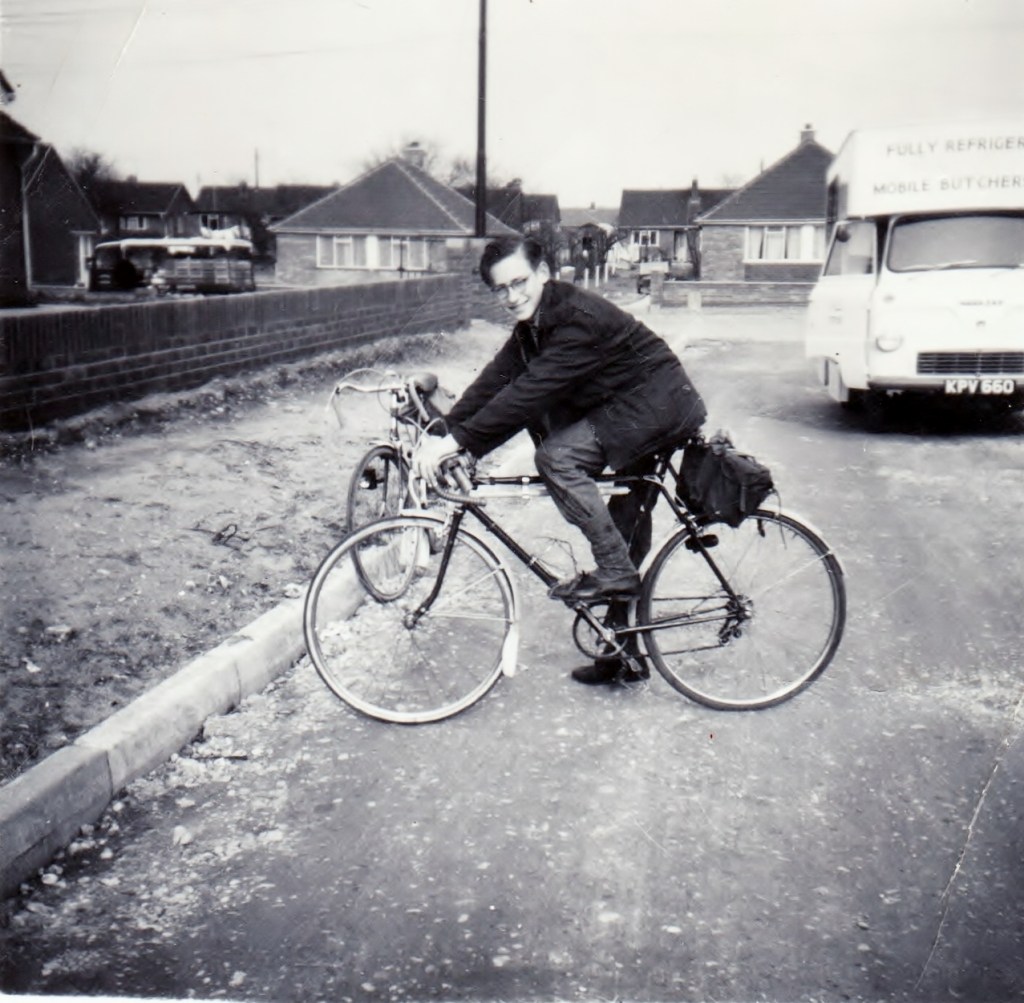
When our family moved to Kesgrave, near Ipswich, in 1958 I was thirteen. I was (and still am) a stubborn individual, and at school I didn’t like or voluntarily take part in team sports. I’m also short sighted, and it was difficult to see a ball without my glasses. Both my grandfather and my parents were cyclists and it just felt natural that I should follow in their wheel marks. I decided that cycling was the sport for me.
At first, cycling trips were made with the family. We didn’t own a car, so we cycled almost everywhere. I particularly remember family trips to the sea at Shingle Street near Orford, 15 miles from home. The whole family would cycle there, picnic on the huge shingle beach and paddle in the sea. I also regularly cycled about ten miles, through the country lanes, to school, Felixstowe Grammar. I once cycled with Dad from Ipswich to Norwich and back, about 80 miles. There were very few cafés in those days, so we stopped at a pub for food, and you had to be over 14 to go into the bar. Dad surprised me by saying, “If they ask you your age, for f___k’s sake tell them you are 14”.
18/03/1962.
The Suffolk Roads Cycling Club
Dad gradually introduced me to the Suffolk Roads Cycling Club. The Lightweight Shop, Tacket Street, was the focus of the club and where rides started. These were well attended sometimes as many as 20 to 25 turning up. Sundays, we cycled to a pub in the countryside. Places for tea included Stoke Ash, Rattlesden, Henley at the Cross keys and Milton at the Coach and Horses. We had afternoon tea, everyone sitting a big table, the no choice menu was beans on toast, cakes, and gallons of tea from huge teapots. It was a very sociable affair. Evening rides outside the racing season were to country pubs where we played darts and I drank shandy. I still have reasonable darts skills some sixty years later and I soon became adept at lying about my age. As I was still young, fourteen or so, my dad required me to get home early, and I had some huge arguments with him about the time I had to be home. It felt safer on a dark winter’s night to cycle home with club mates rather than leave early to cycle home alone. We covered some big distances on club rides, certainly too far for my age. I particularly remember covering 140 miles in a day; down the A12 to Romford to watch the finish of the Essex Grand Prix, New Zealander, Warrick Dalton, was the winner. We used the main road the whole way, swapping leads in a tight group untroubled by the light traffic that would have been on the main road at that time. One time we did 100+ mile ride and I blew completely and had to stop. As I sat against a haystack, I was fed food and drink by the older club members who then pushed me to a café.

The Lightweight Shop and My First Races
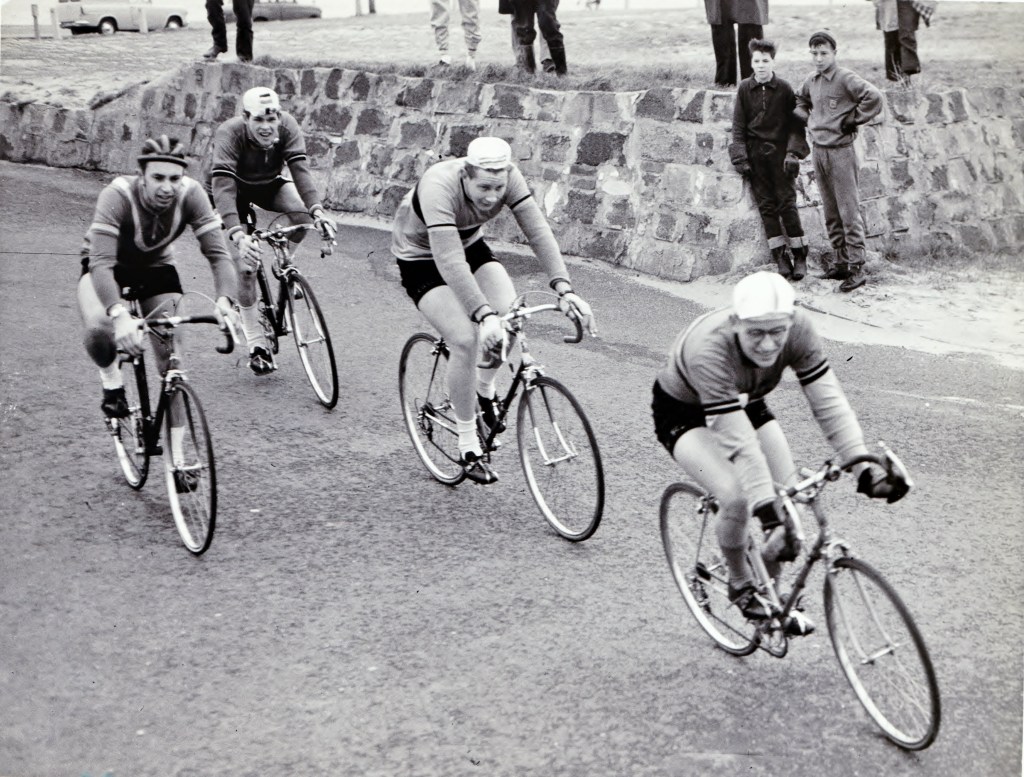
The Tacket Street shop was where we hung out. I went there to buy my cycling kit, meet other club members, and soak up the atmosphere. Invited through to the oily workplace at the back of the shop, we would be offered a cuppa while the mechanic fixed bikes. Race trips were organized, deals were done, and achievements and conquests boasted of (not all of them to do with cycling). I would press my nose against the glass of the shop window and wish I could afford the fluorescent purple bike hanging in the window. Geoff and Joan Mercer, the owners, were always extremely helpful and were heavily involved in organizing races such as the Tour of East Anglia and the Two Rivers Road Race. Geoff was an immense help in getting us younger lads to races and there always seemed to be a seat in his Singer Gazelle. The many rides led to racing, initially evening 10s. These events started outside the Sorrel Horse, a pub on the Norwich Road. I soon became quite good for a junior, producing a 24:46 at the age of 17. Summers were hot and a pint of shandy after the race slipped down beautifully. I will always associate that shandy after a race with the song Runaway by Del Shannon, which I must have heard on the juke box in the pub.
The National Schoolboys Championship
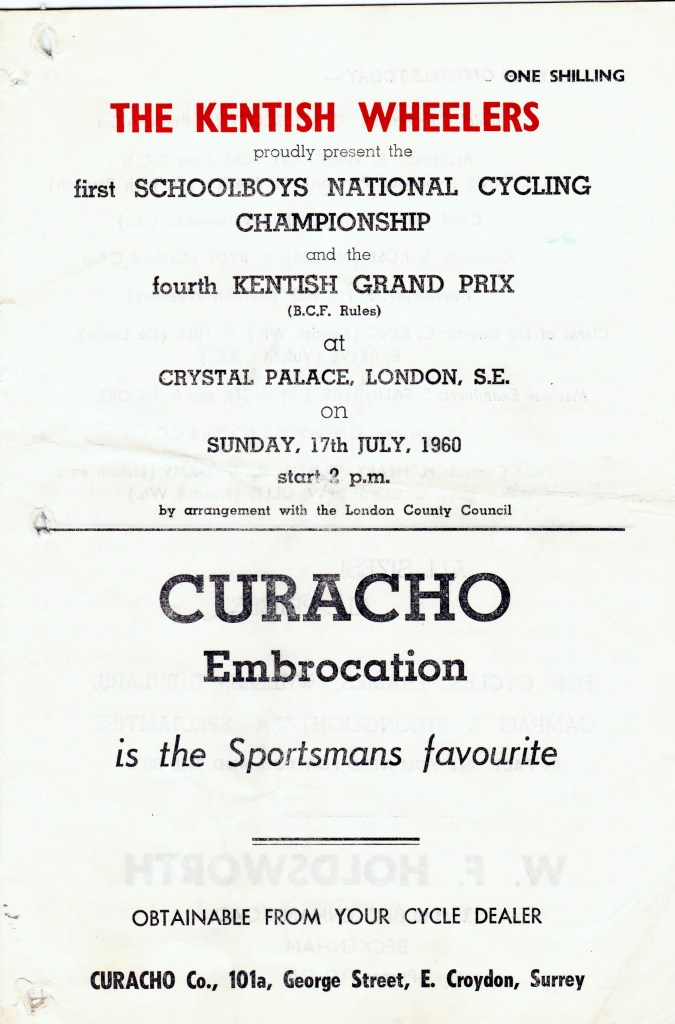
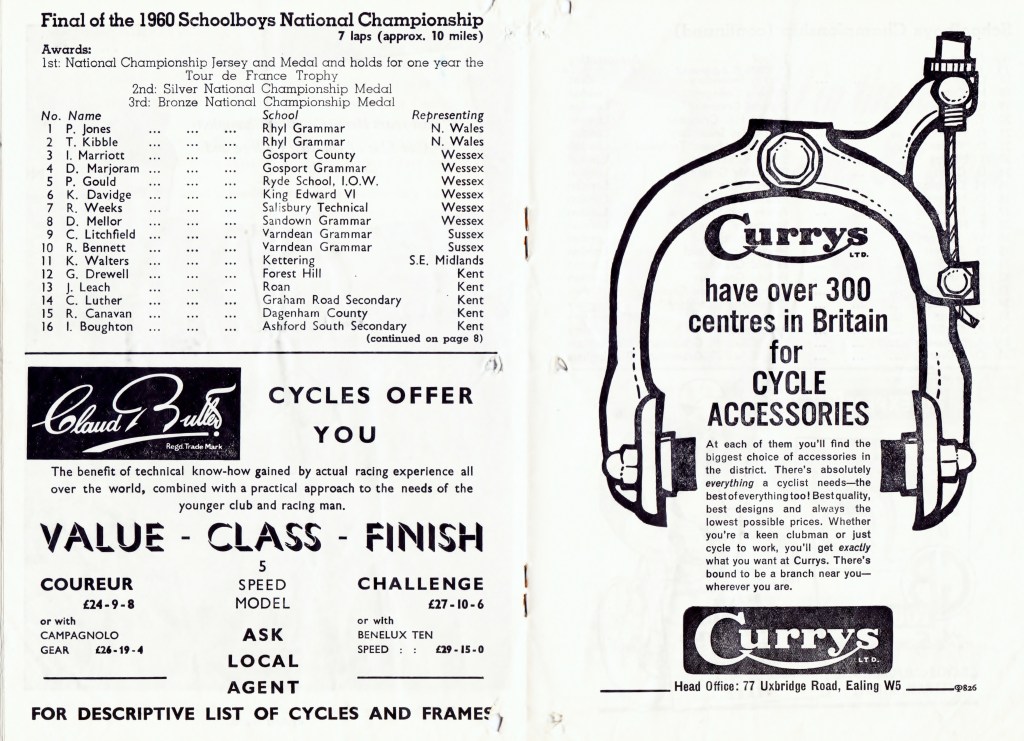
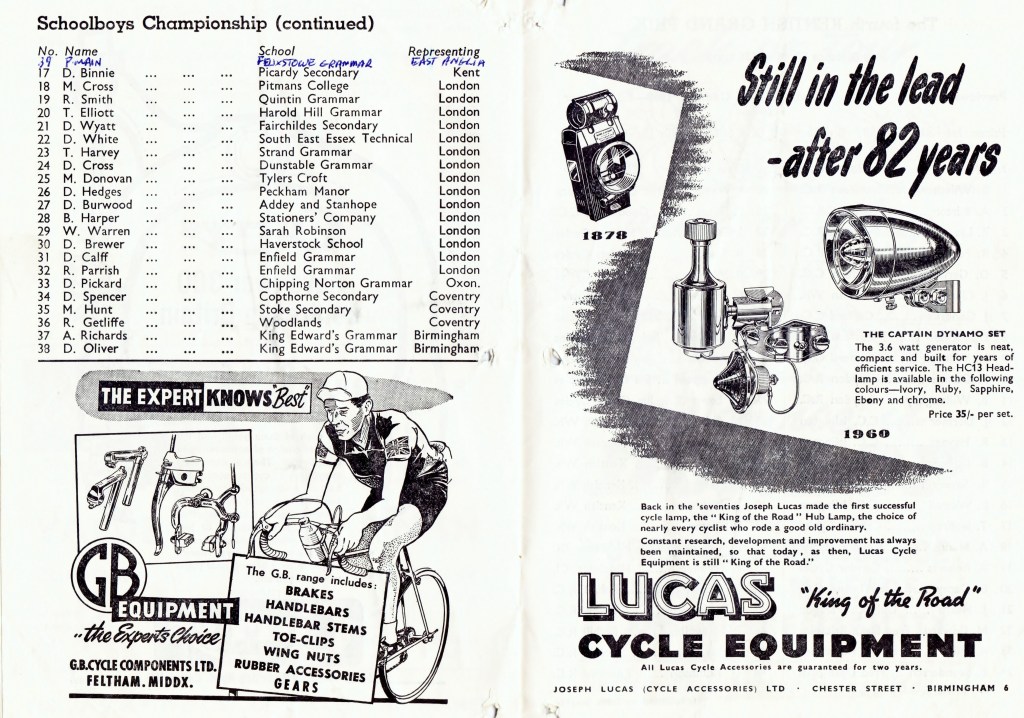
I did well in the local heat of the National Schoolboys’ Road Race Championship. There were two of us at the front in a breakaway and, not knowing what the yellow flag was for (200 yards to go), I asked the other rider what it meant, he just took off, left me, and won. I came second. Geoff Mercer took us down to Crystal Palace for the final on the former motor racing circuit. I was pleased to finish 10th. There was a film of that day taken by someone in the Suffolk Roads, I would love to see it, but I have no idea where it is. Does anyone know?
Cycling Club People and Races
These notes would not be complete without some mention of the characters in the cycling club. My hero was Ged Coles who won the King of Mountains in the Tour of Britain in 1964 and rode as a professional for Ted Gerrard Cycles and Condor-Mackeson. He was a quiet character with a strong Suffolk accent; when I asked him what it was like to be professional, he simply replied, “awright”. We had chain gang group training on summer evenings where I held my own, mostly, OK for a teenager. If Ged was with us, about ten miles from Ipswich he would suggest that we, “gew ard” and that was the last we would see of him. The Suffolk Roads had several other good standard riders, including Bill Seggar, who won the NCU National Road Race Championship in 1958, Johnny Tovell, Mick Hill and John Laws.
The Suffolk Roads promoted the Two Rivers Road Race in early Spring on the Holbrook circuit, near Ipswich, I raced in the Junior event in 1961 and did well to finish 8th. The field in the senior race consisted of a mix of amateurs and professionals, I looked on in awe at the new Ted Gerrard team of Woodburn, Harvey, and Engers. They had all been top amateur time trialists and had turned pro to try their hand at road racing. Years later Engers was the first man to go under 50 minutes for a 25-mile time trial. He was quite an individual character, nicknamed ‘King Alf’, who had many run-ins with officials. He would turn up for time trials wearing his trademark, a huge, fur coat, looking like a rock star, though I believe he was a pastry chef. Woodburn was also a great champion who continued racing into old age. Over the years he produced many amazing performances, including breaking the Land’s End to John O’Groats record.
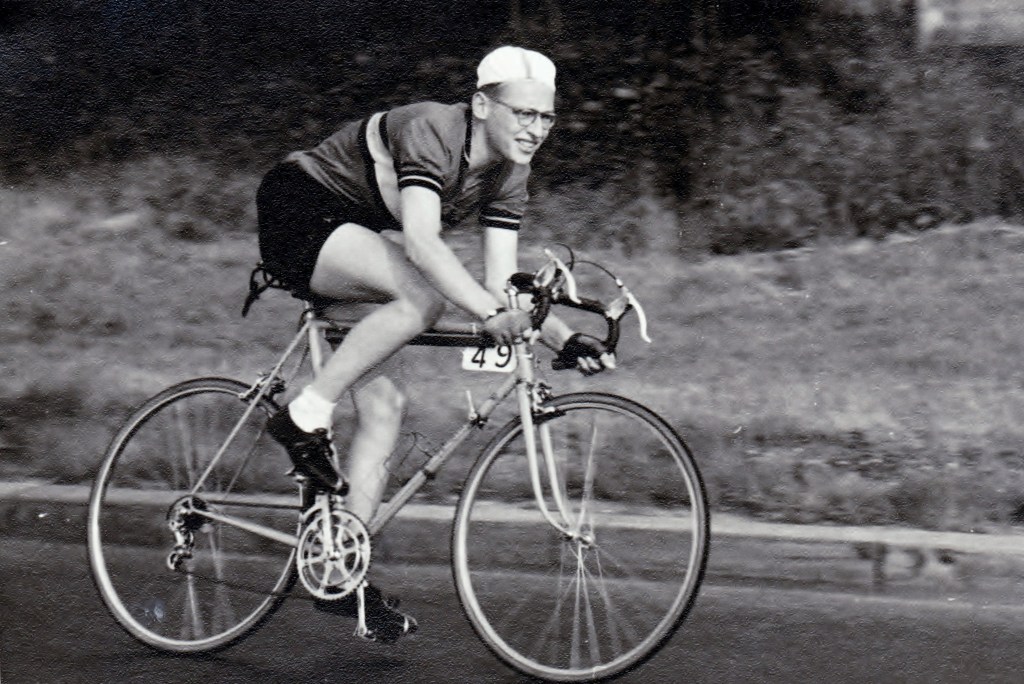
10/06/1962
After moving away from Suffolk, I returned to ride the senior Two Rivers Road Race, in February 1965 when I was nineteen, the field again included professionals. The level of racing was way above what I could cope with; I was outclassed, on a freezing day, and retired after about 45 miles. I wrote in my diary that my hands were so cold I couldn’t use the brake levers. That year I found the transition from junior to senior ranks exceedingly difficult and retired from many races though I did a lot better in later years as I got older and stronger.
They were good times. I was young, I was fit, the summers were hot and long. I had few responsibilities, just many happy miles of cycling. I wish I had more photos of that time, but my interest in photography didn’t start until later.
In 1962, when my dad changed his job and we moved down to Essex, I finished school, started work as an apprentice electrical engineer, and joined the Goodmayes Wheelers, the club my dad had been a member of since 1930.
Professionals, Independents and Amateurs
I have, until now, ignored the differences between independent and professional riders. At that time in the UK, independents were riders who raced for money and were commercially supported, although they also had regular jobs during the week. The ‘real’ professionals were those racing in big European teams.
Back then, if you weren’t professional or independent, you were amateur and would be in big trouble if you won any prize money or raced with a trade name on your clothing. You were even in trouble if a magazine such as ‘Cycling’ published a picture of you racing and the name of the frame maker was visible on your bike. Some riders were even suspended for that ‘offence’: preposterous! If you decided that racing as a professional wasn’t for you and you wanted to revert to amateur status and race for fun, you had to take at least year out of competition.
Prizes for races were limited to bits of cycling kit, medals or household goods donated by local shops. There was a ‘brown envelope’ system for handing out cash which everyone knew about, and no one spoke about. Was I ever handed a brown envelope containing some cash, as well as winning a prize? I’m not telling, I don’t want to be suspended! All these rules were a throwback to the Victorian era of ‘gentleman’ cyclists ingrained into the system. I suspect some officials actually enjoyed mis-using their ‘power’. It took years to get rid of these archaic rules; nowadays there are just age, gender, and ability related categories. Much more sensible.
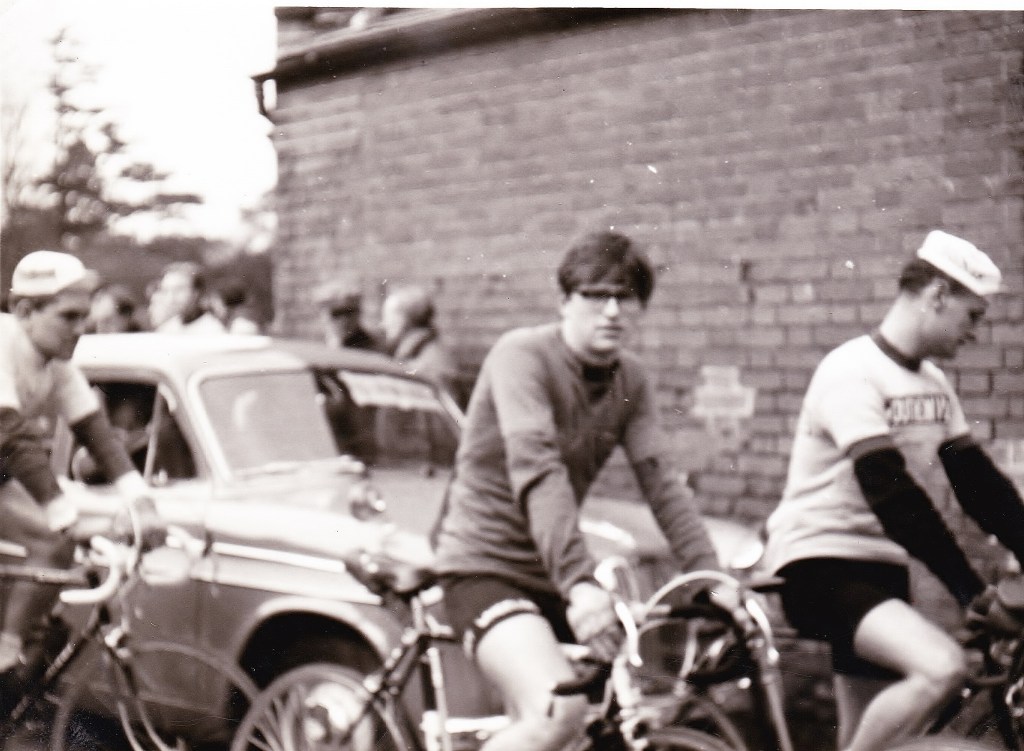
I have endeavoured to 'fact check' this article but corrections would be welcome
©Peter Main – 2022
You are welcome to use extracts from this text but please give me a credit as author
Martin Hodder sent this additional information
Nice to see something written about the SRCC, and well done to Peter for doing it. Obviously it covers activities and people in the Sixties because that’s when Peter was involved, but maybe one of the very small group of us still around who were riding with the club in the Fifties, when it was in its heyday, should tell the story of the people who made the club the fighting force it was. For example, Geoff Mercer has never had recognition for the massive contribution he made to cycling in eastern England. In the days of the BLRC we were a small club, yet had the distinction of three of us holding 1st Cat licences – Ged Coles, Bill Seggar and myself. Between us we won a lot of races, Bill taking the NCU national championship (as stated) and me twice winning the regional junior championship among other junior and senior races. I was rubbish at time trials (best 50 time 2hrs 10min when I was 17), but Bill and Ged were in the upper levels, and we were also winners in the numerous grass track events held around East Anglia, and sometimes further afield.
- Like

 Pete's Stuff
I think the T Bowers you refer to was a clubmate of mine in Upton Manor CC back then.
LikeLike
I didn’t mention a T Bowers in my post?
LikeLike
Funny I am sure I saw the name in the result of a TT you mentioned which he won. Have gone back over the article but cannot find it ! A senior moment perhaps ?
LikeLike
John – apologies. T Bowers, I didn’t mention him in the text but I had forgotten I put him in as the winner of my first 50 as part of a photo caption, , oooops
LikeLike
Two Old Codgers then. Keep Well !
LikeLike
great read , I LIVE IN IPSWICH now, but grew up in South London. I rode the tour of East Anglia in 1965 , currently with the IBC.
Mick Hearn
LikeLike
Thanks for your comment. One of the things I would like to know is how long did the Suffolk Roads CC last and what happened to Geoff and Joan Mercer. I have this idea from somewhere that the immigrated to Australia!
LikeLike
They did move to Australia about 1970
LikeLike
Great memories of days gone by and the members mentioned. I raced against most of them in the late 50/60s. You never mentioned, the keenly fought football matches with my club Colchester Rovers CC.
LikeLike
Robin – you are right, I should have mentioned them, especially as I played in one. All I remember is a freezing cold winter day, a very muddy pitch and the fact I scored on a volley from near the half-way like. It was luck rather than judgement and I was really surprised and very pleased it happened. Who won? I have no idea.
LikeLike
Hi Pete. Just found this article by accident as I was looking up some info on Bill Seggar, as I’d just found a photo of him at the Tour of Britain while looking for something else. Nice to see a mention of John Laws too – he was my stepfather for forty years until he sadly passed away in 2021. I still have a couple of his Suffolk Roads jerseys (I think – they might be West Suffolk Wheelers) and other some other memorabilia. There is also a large pile of cycling photos from the 50s, but they’re in the keeping of his nephew – I need to borrow them to scan at some point.
LikeLike
Hi Pete. Interesting to read your reminiscences and nice to see my stepfather, John Laws, getting a mention! He was always nostalgic about his racing days, and still had his bikes until not long before he passed away in 2021 here in France. I’ve still got a couple of his Suffolk Roads jerseys!
LikeLike
Hi Pete, during my ride today near Kirton, I met Mr Ged Coles! 88 years old and out on his road bike. We rode a few miles and chatted about his pro cycling days in the 60s’. He still rides regularly and is on his indoor trainer every day.
LikeLike
Hello everyone….thanks for the memories of the Tacket St cycle shop Ipswich Suffolk Uk. I was fourteen and lucky enough to have a new racing bike and cycling shoes from Geoff Mercer’s great shop. I used to see all you riders meet up outside the shop and only wish I could ride with you all.
Alas, I was too young and very uninformed in those days, but I use to go out on my own for rides to Belstead and surrounding countryside. Did go as far as Felistowe and Holbrook. Fun times, I really enjoyed the freedom of cycling.
One night unbeknownst to me a police car followed me home from Hawthorn Dr, down through the docks to Fore St. It finally stopped me and a Policeman informed me I had no back lights????? Really, I had no idea.
I was in seventh heaven sailing down hills in the dark, hardly any traffic, til Fore St.
Those were the days. Long gone now but oh so still vivid and fun to recall. Take care, God bless Sally
LikeLike